
Wildlife & Rodenticides
What Are SGARs?
Second-Generation Anti-Coagulant Rodenticides (SGARs) are a class of rodent poisons that lead to fatal hemorrhaging in rats by preventing blood clotting. Currently used in commercial bait traps as a method to control rodents, the poison can spread to other animals—including raptors and foxes—who prey on these rodents. These predators then develop painful and often fatal internal bleeding.
While federal law bans the retail sale of SGARs, these poisons remain legal—and widely used by licensed pest control professionals in Massachusetts. SGARs are placed in black bait boxes and include:
Brodifacoum (Brand names Mouser, Ratak, Talon)
Bromadiolone (Maki Mini Blok, Contrac)
Difenacoum (Di-Kill)
Difethialone (First Strike, Hombre)
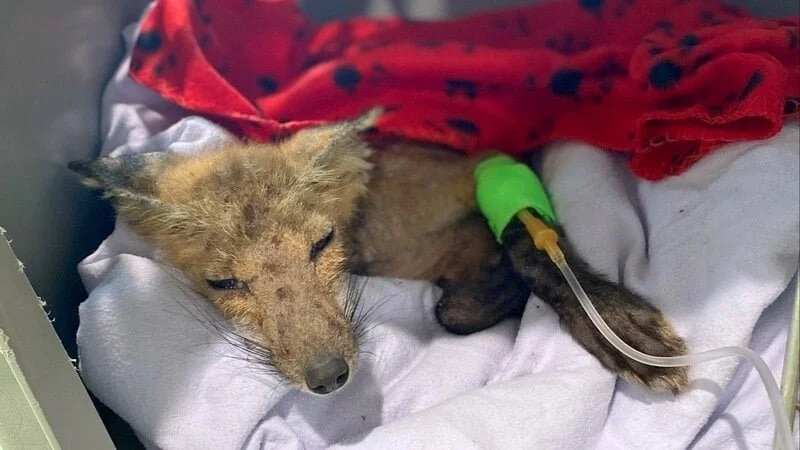
A Red Fox receives treatment for rodenticide poisoning. If an animal is rescued soon enough, a treatment of Vitamin K can help support blood clotting and aid in recovery. Source: Newhouse Wildlife Rescue
How SGARs Poison Our Wildlife and Communities
Although pest control professionals use SGARS to target mice and rats, these deadly poisons move throughout the food chain, with destructive consequences to the entire ecosystem.
SGARs work slowly: after ingesting bait, a rodent may live for several days, during which time it becomes more vulnerable to predators and scavengers. When a predator eats a poisoned rodent, SGARs pass into its own bloodstream in a process known as “secondary poisoning.” Just like a rodent that has ingested SGARs, a predator that consumes enough poisoned rodents will develop serious internal bleeding, leading to serious illness or death.
In recent years, researchers have documented an alarming number of predators sickened and killed by SGARS. Veterinarians at the New England Wildlife Centers report treating hundreds of poisoned raptors, foxes, and coyotes each year.
A recent study found that 100 percent of Red-tailed Hawks tested at a wildlife clinic in Massachusetts had SGARs in their bloodstreams. And a national study of 303 dead Bald Eagles found that 82 percent of the sampled birds had been exposed to rodenticides. Many of these birds died from other causes like collisions with vehicles, but exposure to rodenticides reduces an animal’s health and alertness, making it more susceptible to hazards.
There’s no way to precisely track how many predators have been killed by SGARs in the wild. However, the anecdotal evidence suggests that the use of these poisons are systematically weakening species at multiple levels of the food chain.
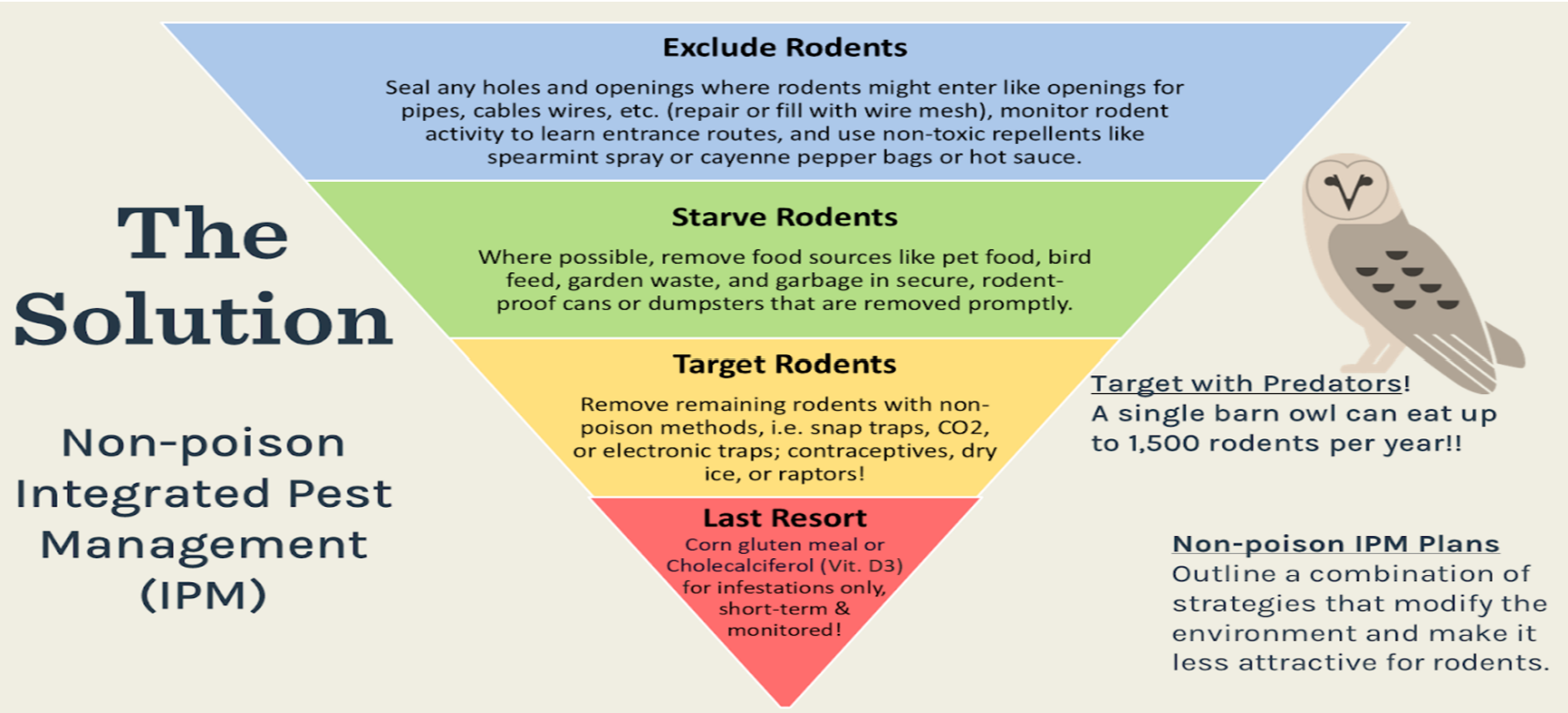
Integrated Pest Management is an approach to solving a pest infestation. While the steps will vary depending on the species, generally IPM involve Exclusion (sealing entry points), Starvation (remove food sources), Target (preferably with non-poison methods). Source: Mass Audubon
What Is Integrated Pest Management?
The only way to permanently keep rodents out of an indoor space is through a process called Integrated Pest Management (IPM)—a combination of strategies that modify the environment and make it less attractive to unwanted species. IPM for rodents can be broken down into three steps:
1. Exclude: Rodents fit through holes as small as a dime… therefore:
Seal any holes in roofs, basements, crawlspaces, and walls. Fine-grade steel wool is useful to plug holes, rodents are irritated by chewing through this material.
Use wire mesh extending partially into the ground to block off spaces under porches to help avoid burrowing.
Seal opening around cables, pipes, and wires where rodents could potentially enter your space.
2. Starve: Rodents will eat almost anything!
Never leave pet food out for prolonged periods.
If you feed birds, only use small amounts of seed at a time.
Harvest all food in gardens quickly.
Keep garbage cans securely covered. Avoid leaving uncanned garbage bags outside overnight.
3. Target: Without food or access, rodents won’t last long. If you must get rid of remaining rodents quickly, consider non-poison methods, such as:
Snap-traps: be sure to only use snap traps where they cannot be accessed by children, pets, or other wild animals.
Electronic traps: these instantly and painlessly kill rodents without harming other animals.
Rodent contraceptives: products that reduce rodents’ fertility, reducing their populations gradually over time. These are delivered in bait boxes similar to other chemical applications.
CO₂ traps: These traps immediately and painlessly kill rodents by suffocating them with sudden bursts of CO₂ once they enter traps.
Never use glue traps—they trap rodents without killing them, causing immense suffering, and they often capture birds and other animals.

Owls can eat close to 2,000 live rodents per year. Because rodenticides can take 3-7 days to kill a rodent, this not only allows time for reproduction, but also makes for 'easy prey'. However the poisons add up in the hunter's body (bioaccumulation), causing a secondary poisoning impact on predator species. Source: Mary Sapienza via Mass Audubon
SGARs in Maynard
In May 2025, Maynard residents voted in favor of banning the application of all anticoagulant poisons on municipal property including Town Hall, Fire Station, and public schools. Work is underway to propose a Home Rule Petition that would restrict external use on private property in Maynard. Federal law requires pest control professionals to place SGARs within tamper-proof bait boxes, typically made of black plastic and roughly the size of a shoebox. Pest control professionals generally place bait boxes in places with high rat populations, like basements, attics, alleys, or under porches. All interior bait boxes must be clearly labeled with the type of poison they contain. Exterior boxes must be labeled with the installer contact information.
Learn more about rodent control and Mass Audubon’s Rescue Raptor Campaign:
Non-Poison Integrated Pest Management Toolkit (via MA, NH, & RI Audubon Societies)
Integrated Pest Management Resources and Options (shared by Friends of Horn Pond)
Raptors Are The Solution (RATS): Preferred Pest Control Products
Join the effort!
Mind your own home: seal openings, reduce access to food waste, and try alternative trap methods.
Ask your vet if they have encountered any domestic pets impacted by SGARs. Keep us posted at Green Maynard.
Contact our local reps (Senator Eldridge and Representative Hogan for Maynard) to thank them for their continued support for “The Hawkins Bill” An Act restricting the use of rodenticides in the environment (H965/S644), which reduces use of this dangerous poison on all property across Massachusetts.
Updated January 2026